
Last updated July 7, 2026
Garage Door Emergency Preparedness Guide for Irving Homes
During the February 2021 ice storm, garage door service calls across DFW spiked 400% in 48 hours — and most of those failures were preventable. A third of the callers we fielded were trapped inside their own garages, standing in the dark, pulling on a manual release cord they’d never touched before. Irving sits in a severe weather corridor where thunderstorms, tornadoes, and ice events aren’t rare surprises — they’re seasonal realities. Your garage door is the largest opening in your home, and when it fails during an emergency, it becomes a security breach, a weather vulnerability, and a trap. In this guide, you’ll learn how to prepare before the storm, what to do when your door fails, and how to avoid the mistakes that turn a $200 repair into a $2,000 problem.
Quick Answer
Irving homeowners should keep a five-item emergency kit in their garage, test their manual release monthly, and inspect weatherstripping and track alignment before every severe weather season. When failure happens, know how to secure the door temporarily and call a professional who stocks parts for your specific opener brand — most emergency garage door repairs in Irving are completed same-day when the right parts are on the truck.
Table of Contents
- Why Irving’s Weather Makes Garage Door Preparedness Essential
- How to Use Your Garage Door Manual Release Cord Safely
- Pre-Storm Preparation: Your Irving Garage Door Checklist
- The $40 Emergency Kit Every Irving Garage Should Have
- How to Temporarily Secure a Non-Functional Garage Door
- What to Tell Emergency Dispatch to Get the Right Tech Fast
- Common Mistakes to Avoid
- When to Call a Professional
- Frequently Asked Questions
Why Irving’s Weather Makes Garage Door Preparedness Essential
Irving sits at the intersection of Tornado Alley and the southern plains ice corridor. That geography isn’t abstract — it shows up in our service logs every year. In March and April, straight-line winds from supercell thunderstorms test every panel and track in Valley Ranch and Las Colinas. In January and February, ice accumulation seizes rollers and burns out LiftMaster and Chamberlain opener motors trying to lift frozen doors. We’ve replaced more torsion springs after sudden temperature drops than we can count.
The physics are straightforward but unforgiving. A standard 16-foot garage door weighs 150 to 200 pounds. The torsion spring above the header does the lifting work — not your opener. When that spring breaks, usually with a sound like a gunshot, the opener strains against dead weight. In cold weather, metal contracts, lubricant thickens, and the margin for error shrinks. A door that groaned slightly in October will refuse to move in February.
Here’s what we’ve observed across eight years of Irving calls:
- Spring failures peak in temperature swings: When Irving drops from 70°F to 25°F in 24 hours, we field 3x normal spring replacement calls. The thermal contraction stress on already-fatigued metal is the trigger.
- Wind load damages track alignment: Doors in exposed areas — near the Trinity River corridor, in open subdivisions without mature tree buffers — see more horizontal track bending from pressure differentials during severe thunderstorms.
- Power outages compound mechanical failures: When Oncor lines go down during a storm, homeowners discover their opener’s battery backup is dead or missing — and they don’t know how to use the manual release.
- Garage door repair in Irving demand surges 300-400% during regional weather events, stretching response times for everyone.
The homeowners who weather these events smoothly aren’t luckier — they’re prepared. They’ve tested their manual release, they’ve inspected their hardware seasonally, and they know who to call before they’re standing in a dark garage with rain blowing in.
How to Use Your Garage Door Manual Release Cord Safely
The red cord hanging from your garage door opener trolley is your escape route when the power fails or the opener malfunctions. Used correctly, it disengages the door from the opener so you can lift it manually. Used incorrectly, it can damage the opener, derail the door, or — with broken springs — cause serious injury.
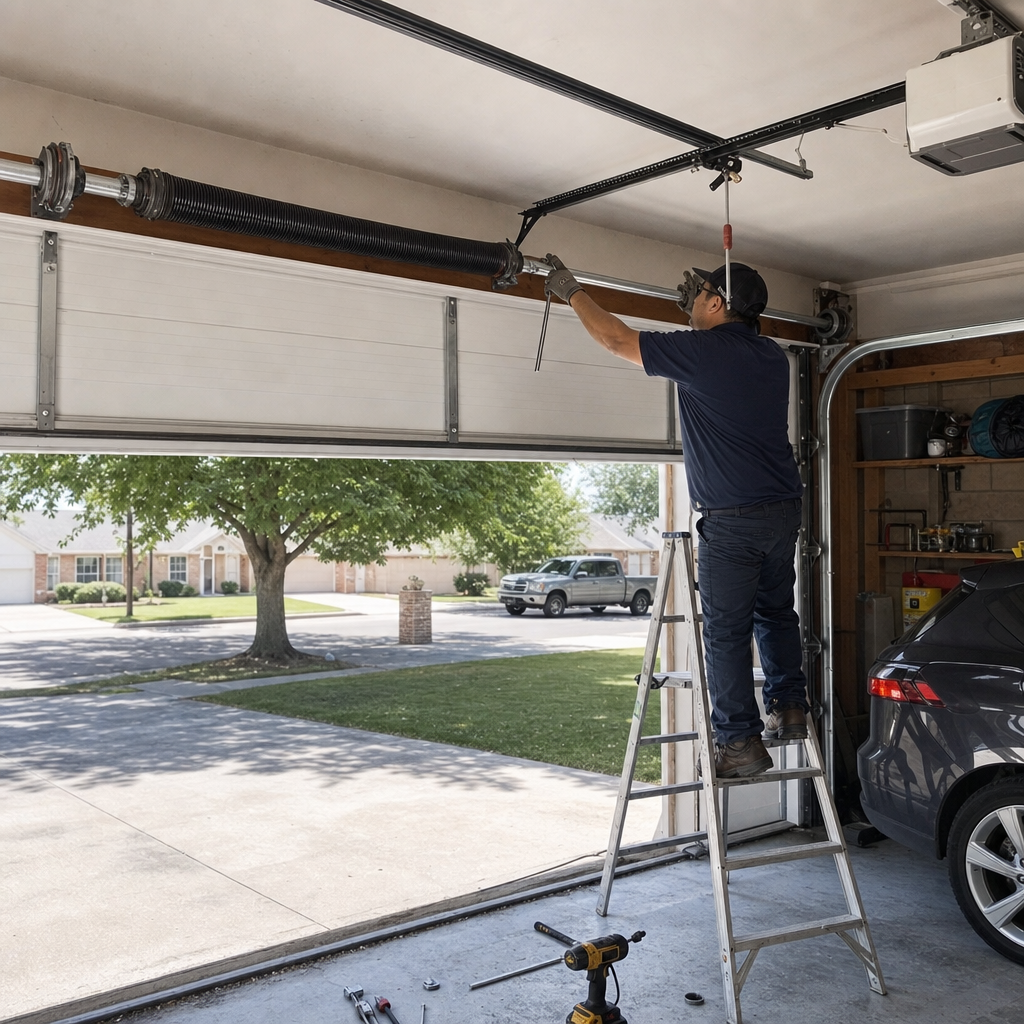
Before you pull anything, assess the spring status. Look at the torsion spring above your door. Is it in one continuous coil, or is there a visible gap? If there’s a gap, the spring is broken. Do not attempt to lift the door manually — a 200-pound door without spring assistance is a crushing hazard. This is when you call for Sunbelt Garage Door Service Dallas Fort Worth home emergency response.
If the spring appears intact, follow these steps:
- Close the door fully if possible. The release is designed to work with the door in the down position. Releasing a partially open door can cause it to slam shut if the spring is weak or improperly balanced.
- Pull the cord straight down, not toward the door. The release mechanism is directional. Pulling toward the door can bend the trolley engagement lever, creating a repair that didn’t exist before.
- Listen for a distinct click. That click is the trolley disengaging from the opener carriage. No click means the mechanism may be stuck or already disengaged.
- Lift the door smoothly with both hands, evenly. A properly balanced door should lift with moderate effort — roughly 10-15 pounds of pressure. If it feels like 50+ pounds or won’t stay open at waist height, the spring is failing or the door is unbalanced. Lower it gently and stop.
- To re-engage: Pull the cord down again (some models require pulling toward the opener motor), then run the opener until the trolley reconnects with the carriage. You’ll hear it click into place.
What NOT to do: Never pull the release cord while the opener is actively running — this strips the trolley gears in Genie and older Chamberlain units. Never tie the cord up out of reach; you need immediate access during an emergency. And never let children practice this unsupervised.
In Irving’s frequent power outage events, we’ve found that homeowners who test this quarterly — literally walk out to the garage and run through the steps — handle actual emergencies with confidence. Those who wait until the storm are the ones calling at 11pm, frustrated and vulnerable.
Pre-Storm Preparation: Your Irving Garage Door Checklist
Every severe weather season — late March for tornado threats, late November for winter events — Irving homeowners should run through a focused inspection. It takes 15 minutes and addresses the failure points we see most often.
Track and Roller Inspection
With the door closed, examine the vertical tracks on both sides. Are they plumb and parallel? A gap wider than 1/4 inch between the track and roller indicates pending derailment. Check rollers for cracks — nylon rollers degrade in Texas heat and become brittle. Steel rollers rust if lubrication has been neglected. In Las Colinas and Hackberry Creek, where homes are closer together, wind-driven debris impact accelerates roller wear.
Spring and Cable Visual Check
Look at the torsion spring for rust pits, coil separation, or shiny wear marks where coils are rubbing. Check the lift cables where they wrap around the bottom fixtures — fraying here is a failure in progress. If you see more than three broken strands in a one-inch section, the cable needs replacement before it snaps under load.
Weatherstripping Integrity
Irving’s summer heat and winter ice both attack the bottom rubber seal. A compromised seal lets water pool at the door base during thunderstorms, which then freezes and adheres the door to the concrete — a common cause of opener strain and stripped gears in Chamberlain and Craftsman units. Replace the seal when it’s cracked or no longer compresses to fill the gap.
Opener Force Settings Test
Place a 2×4 flat on the floor where the door closes. Run the door down — it should reverse on contact. If it doesn’t, the force setting is too high and the safety reverse is compromised. This is a critical check before any storm where you might need the door to auto-reverse if debris blows underneath.
Battery Backup Verification
Since 2019, California-style battery backup requirements have influenced national manufacturing, but many Irving homes still run older LiftMaster or Raynor openers without backup power. Test yours by unplugging the opener and attempting operation. If there’s no backup, consider that your door is dead weight during the next Oncor outage — and plan accordingly.
Lubrication — Correctly
Use silicone-based spray lubricant on rollers, hinges, and springs. Never use WD-40 as a lubricant — it’s a solvent that strips protective oils. In Irving’s dusty conditions, avoid grease that attracts grit; it turns into abrasive paste. Lubricate lightly, wipe excess, and run the door several times to distribute.
The $40 Emergency Kit Every Irving Garage Should Have
After eight years of emergency calls across Irving, we’ve identified five items that resolve or mitigate 80% of after-hours garage door crises. Total cost: under $40. Store them in a labeled container on a shelf you can reach without opening the garage door.
| Item | Purpose | Cost |
|---|---|---|
| LED headlamp | Power outage visibility — hands-free operation of manual release | $8–$12 |
| Silicone spray lubricant | Free seized rollers, hinges, or weatherstripping adhesion | $6–$9 |
| Locking pliers (2) | Clamp tracks to secure a failed door temporarily | $10–$14 |
| Heavy-duty zip ties (10-pack) | Secure loose cables, attach temporary weather barrier | $4–$6 |
| Flashlight with magnetic base | Inspect springs, cables, track alignment in dark garage | $8–$12 |
Here’s how these play out in real Irving scenarios:
The frozen door at 6am: Spray silicone along the bottom seal where it’s adhered to concrete. Wait two minutes. The door releases without forcing the opener.
The broken spring with a car inside: Use the headlamp to assess. If the spring is clearly broken, don’t attempt manual lift. Use locking pliers to clamp both tracks just below the bottom rollers, preventing the door from being forced open from outside. This creates temporary security until morning.
The derailed door during a storm: Zip ties can secure a displaced cable temporarily, preventing further damage. This is strictly a “get through the night” measure — the door needs professional re-tracking before safe operation.
How to Temporarily Secure a Non-Functional Garage Door
When your garage door won’t close or lock — whether from a broken spring, failed opener, or derailment — your home is exposed. In Irving, where property crime rates track above national averages in some neighborhoods, an open garage overnight is an invitation. Here’s how to secure it until professional repair arrives.
For a door stuck open:
- Disconnect power to the opener. Unplug it or flip the breaker. Prevents accidental activation that could worsen the problem.
- Clamp the tracks. Position locking pliers on both vertical tracks, just above the bottom rollers. This prevents the door from rolling down unexpectedly if spring tension releases.
- Block the door base. Use a 2×4 or similar solid barrier in the door path as a physical stop.
- Secure the emergency release. Tie the red cord up and out of reach from outside — some burglars fish for it with coat hangers through the top of the door.
- Cover the opening temporarily. Heavy-duty plastic sheeting or a tarp, secured with boards screwed into the door frame, creates weather and visual barrier. Not security-grade, but better than gaping open.
For a door stuck closed with a broken spring:
Do not attempt to force it open. The door is held by the opener’s internal resistance and the weight distribution on the cables — an unstable equilibrium. Forcing it can snap cables, damage panels, or injure anyone nearby. Instead, use another entry, secure the interior garage door to your home, and call for morning service.
In Valley Ranch and Cottonwood Valley, where many homes have alley-facing garages with limited visibility, temporary security is especially critical. We’ve responded to calls where a failed door left open overnight resulted in stolen tools and bikes — a secondary loss that proper temporary securing would have prevented.
What to Tell Emergency Dispatch to Get the Right Tech Fast
When you call for emergency garage door service, the information you provide determines whether the technician arrives with the right parts and the right expertise — or makes a second trip, charging you for the delay.
Here’s what we need to know at garage door opener in Irving dispatch:
- Door dimensions and type: Single or double car? Steel, wood, or composite? This determines spring size and panel availability.
- Opener brand and approximate age: “It’s a Genie from maybe 2015” gets us closer than “the motor thing.” If you can see a model number on the unit, even better. We stock parts for LiftMaster, Chamberlain, Genie, Raynor, and other major brands, but the specific part varies by generation.
- Symptom, not diagnosis: “The door goes up six inches and reverses” is more useful than “I think the sensor is broken.” Describe behavior, not your conclusion.
- Spring status if visible: Is there a gap in the torsion spring? Are cables dangling loose? These are safety-critical details that affect dispatch priority.
- Security urgency: Door stuck open overnight in an exposed location gets different scheduling than a door stuck closed with no immediate security concern.
- Access constraints: Gated community, apartment complex, alley-only access — these affect arrival time and vehicle selection.
Frank Hughes and his team have handled every permutation of these calls across Irving. The homeowners who get fastest resolution are those who’ve looked at their system before calling and can answer follow-up questions without running back to the garage. Take a photo of your opener model plate and save it on your phone — it’s the single most useful prep step we recommend.
Common Mistakes to Avoid
- Pulling the manual release with the door open and a broken spring. The door will slam down with lethal force. We’ve seen crushed fingers, damaged vehicles, and bent tracks from this single error. Always verify spring integrity before releasing.
- Using the garage door as the only storm prep check. Irving homeowners who focus on windows and roofing but ignore the garage door are leaving their largest opening unprotected. Wind pressure differentials can blow in a compromised garage door and pressurize the entire structure.
- DIY spring replacement after watching online videos. Torsion springs store massive energy. Improper winding tools or technique cause serious injury annually. This is not a homeowner repair — the risk-reward calculation never works.
- Ignoring the “small” grinding sound. In our experience across 570+ Irving-area jobs, the grinding roller or squealing spring that “isn’t that bad” becomes the 2am failure during the ice storm. Address it in October, not February.
- Assuming all openers work the same in emergencies. Chamberlain’s MyQ battery backup behaves differently from Genie’s Intellicode system. Know your specific unit’s manual release behavior before you need it.
- Waiting until the storm warning to test anything. The time to discover your manual release is stuck is not when the tornado siren is sounding. Quarterly testing takes two minutes and reveals problems while solutions are still easy.
When to Call a Professional
Some garage door situations demand immediate professional attention — not tomorrow, not after you watch another video. Call when: the torsion spring is visibly broken or gapped; cables are frayed or detached; the door is off-track or visibly crooked in the opening; the opener smokes, sparks, or trips breakers; or the door won’t stay open and could fall unexpectedly.
These are safety hazards, not inconveniences. A falling garage door causes severe injury. An electrical fault in an opener can ignite. And a door that’s been forced off-track has compromised structural integrity that temporary fixes won’t restore.
Garage door installation in Irving and repair is what we’ve done for eight years, with 570+ verified reviews averaging 4.7 stars. Frank Hughes, Owner & Lead Technician, personally handles technical work — you’ll speak with him directly, not routed through a call center. When your door won’t move, we will. Sunbelt Garage Door Service Dallas Fort Worth offers free estimates in Irving — call (855) 683-6171.
Frequently Asked Questions
Most emergency garage door repairs in Irving range from $180 to $450, depending on whether the issue is a spring replacement, cable repair, opener component failure, or track realignment. After-hours or severe-weather emergency calls may carry a modest trip charge, but we provide upfront pricing before any work begins. Call (855) 683-6171 for an exact quote — estimates are free.
Yes, most repairs are completed in a single visit when we have the correct parts on our truck. We stock springs, cables, rollers, and opener components for all major brands including LiftMaster, Chamberlain, Genie, and Raynor. Same-day service depends on damage severity and parts availability for older or specialty units. Call early in the day for fastest scheduling.
Repair is almost always more economical for isolated failures — a single broken spring, failed opener, or damaged panel. Replacement becomes cost-effective when the door has multiple failing components, significant panel damage, or is over 20 years old with outdated safety features. We’ll assess honestly and recommend repair when it makes sense. Call (855) 683-6171 for a no-pressure evaluation.
Look for a visible gap in the torsion spring coil above your door, or listen for a loud bang that occurred when the door was last moving. A broken spring means the door feels extremely heavy to lift manually, or the opener strains and may not raise the door more than a few inches. Do not attempt DIY spring repair — the stored energy is dangerous. Call for professional service.
First, verify whether your opener has battery backup by checking for a small battery compartment or indicator light. If not, use the manual release cord to disengage the opener, then lift the door manually — but only if the spring appears intact. If the spring is broken, do not attempt manual lift; secure the door if possible and wait for power restoration or professional repair. Test your manual release quarterly so you’re prepared before the outage.
Inspect seasonally — before severe weather season in March and before winter freeze potential in November. The temperature swings and wind exposure in Irving accelerate wear on springs, rollers, and weatherstripping. A 15-minute visual and operational check, plus annual professional maintenance, prevents most emergency failures we’ve seen in 8 years of Irving service.
The Bottom Line
Garage door emergencies in Irving aren’t hypothetical — they’re seasonal, predictable, and disproportionately destructive because the garage door is your home’s largest moving barrier. The homeowners who fare best have tested their manual release, keep a basic emergency kit, inspect before storm season, and know who to call with the details that get fast, correct repair. Preparation costs under $40 and two hours of your time. Recovery from a failed door during an ice storm or tornado warning costs far more in money, security, and stress. The difference is whether you acted in October or waited until the siren sounded.
Need help preparing your garage door, or dealing with a failure right now? Call Sunbelt Garage Door Service Dallas Fort Worth at (855) 683-6171 for a free estimate. Frank Hughes and his team service all major brands — LiftMaster, Chamberlain, Genie, Clopay, Amarr, Wayne Dalton, Craftsman, and Raynor — and most repairs are completed in a single visit. When your door won’t move, we will.
Written by Frank Hughes, Owner & Lead Technician at Sunbelt Garage Door Service Dallas Fort Worth, serving Irving since 2018.