
Last updated July 7, 2026
The Complete Guide to Garage Door in Irving
Your garage door moves more times per year than your front door does in a decade — yet most Irving homeowners couldn’t tell you the age of their springs or the R-value of their panels. We’ve been fixing, replacing, and installing garage doors across Irving for eight years, and the pattern is always the same: people ignore the system until it quits at 6:47 AM with a car trapped inside and a meeting in an hour. This guide changes that. We’ll walk you through every decision that matters — from spring cycles to panel insulation to opener smart-home compatibility — with Irving’s specific housing stock and brutal North Texas climate as the backdrop, not an afterthought.
Quick Answer
A well-chosen garage door system in Irving should pair cycle-rated torsion springs (10,000+ cycles minimum), steel or insulated steel panels rated for thermal expansion, and an opener with battery backup and smart connectivity — all sized to your door’s actual weight and your home’s wind-load zone. Most Irving homes built between 1980 and 2005 have 16×7 or 8×7 doors with 1⅝-inch or 2-inch tracks, and replacing components with mismatched specs is the single most common cause of premature failure we see in the field.
Table of Contents
- Understanding Your Garage Door System: What’s Actually Up There
- How Irving’s Climate Destroys Garage Doors (And What to Do About It)
- Spring Math: Why Cycle Rating Matters More Than Years
- Panel Materials and Insulation: What Works in North Texas
- Garage Door Opener Guide: Smart Features That Actually Work in DFW
- How to Read Your Hardware Stamps Before Calling Anyone
- Replacement vs. Repair: The Real Cost Math for Irving Homes
- Choosing an Installer in Irving: Red Flags and Green Lights
Understanding Your Garage Door System: What’s Actually Up There
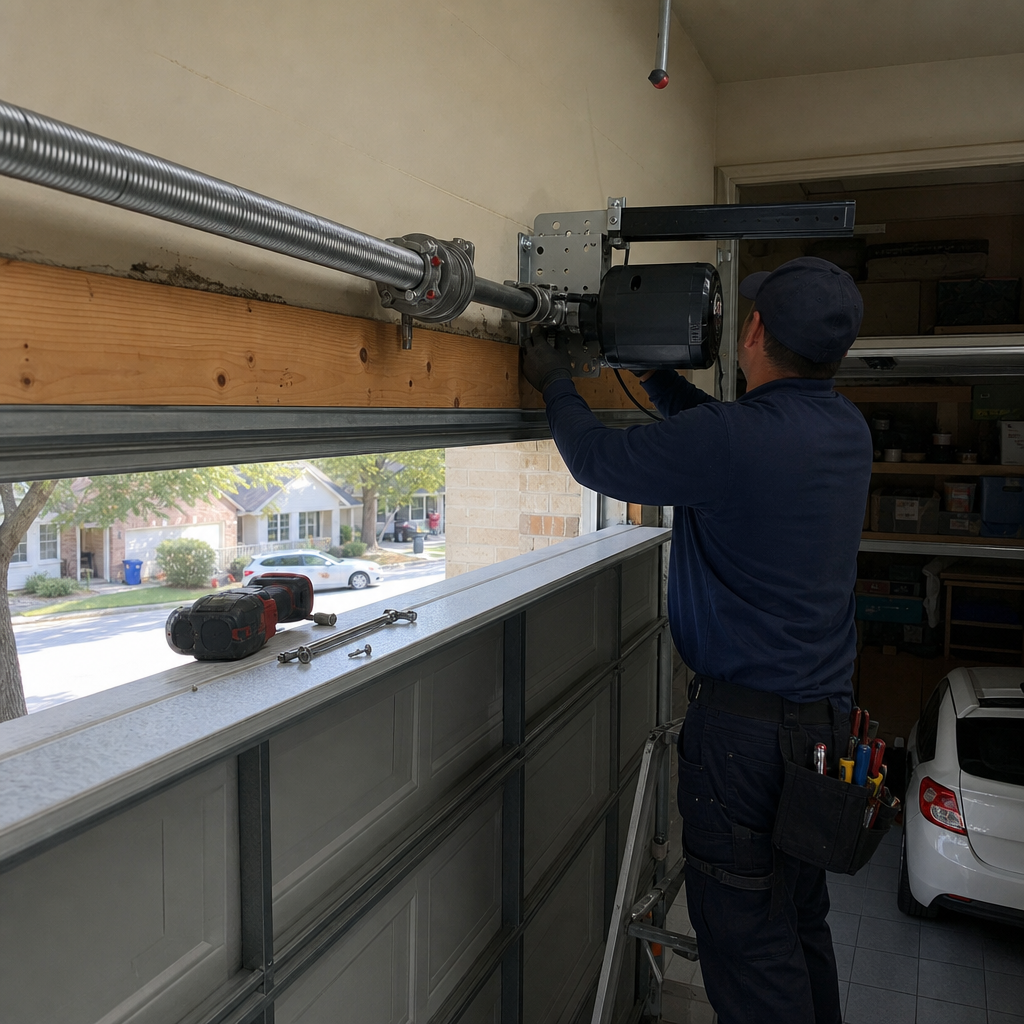
Most homeowners in Irving see a garage door as one thing. It’s not. It’s a mechanical system with five interdependent components, and when one fails, the others compensate until they fail too. Here’s what’s actually overhead:
- The door itself: Panels (steel, aluminum, wood composite, or fiberglass), hinges between sections, and rollers that ride in the tracks.
- The track system: Vertical tracks on each side, horizontal tracks running back toward the motor, and the curved “jamb bracket” section where they meet. Track width matters — 1⅝-inch for lighter residential doors, 2-inch for heavier or insulated models.
- The spring system: Torsion springs mounted on a shaft above the door, or extension springs running parallel to the horizontal tracks. Torsion is standard now; extension springs are legacy hardware, common in Irving’s 1980s builds.
- The cable and drum assembly: Cables wind and unwind on drums as the door moves, translating spring torque into vertical lift. Drum size must match door height — 8-foot doors need different drums than 7-footers.
- The opener: Motor, drive mechanism (chain, belt, or screw), and the safety sensor system required since 1993.
In Las Colinas and Valley Ranch, we see a lot of 1990s homes with original extension spring setups that were never upgraded. The springs stretch and wear unevenly, and when one breaks, the door goes crooked in the tracks. In older Irving neighborhoods like Plymouth Park, the original torsion springs from the 1970s are long past their cycle life — they’re essentially uncoiled metal waiting for a Tuesday morning to snap.
The critical point: every component has a specification. The spring isn’t “a spring” — it’s a wire diameter, inside diameter, length, and wind direction, rated for a specific door weight and cycle count. The track isn’t “a track” — it’s a gauge, width, and radius. When we get a call about a “broken garage door,” the first thing we do is read the hardware stamps. More on that below.
How Irving’s Climate Destroys Garage Doors (And What to Do About It)
Irving sits in the Cross Timbers ecological region, which means you get the full North Texas punishment: 100°F-plus summers with UV index spikes, sudden temperature drops behind blue northers, ice storms that coat every surface, and hail that dents cars and doors alike. National garage door guides don’t account for this.
Summer thermal cycling: An uninsulated steel door in Irving can reach 140°F surface temperature by 3 PM in July. The steel expands, the paint degrades, and the panel seams stress. We’ve replaced dozens of doors in Hackberry Creek where the original builder-grade steel panels had warped so badly they wouldn’t seal against the weatherstripping. If your garage is attached to your house, that radiant heat transfers directly into your HVAC load.
Winter ice loading: The February 2021 storm wasn’t a fluke — it was an extreme version of what happens every few winters. Ice accumulates in the bottom seal and freezes the door to the concrete. Homeowners hit the opener button, the motor strains, and either the opener strips its gears or the door tears free from the bottom fixture. The right fix: a properly sloped driveway apron, a bottom seal with internal drainage channels, and never forcing a frozen door.
Hail vulnerability: Irving gets 2–4 hail events per year that can exceed 1-inch diameter. Standard 24-gauge steel panels dent. Clopay’s Gallery Collection and Amarr’s Classica line with thicker 24-gauge or 25-gauge steel with reinforcement stand up better. For maximum impact resistance, Wayne Dalton’s 9700 series with insulated steel and composite overlay is what we recommend in hail-prone Irving zip codes.
Humidity and corrosion: Irving’s humidity spikes in spring and fall accelerate rust on untreated hardware. We see seized rollers, rust-pitted cables, and corroded bottom brackets in homes within a mile of the Elm Fork of the Trinity River. Galvanized or zinc-plated hardware is worth the upgrade.
Wind load: Irving is in a 90-mph wind zone per IRC standards. If you’re replacing a door, it needs to be rated for your local wind speed with proper reinforcement struts. We see too many online orders that skip this — a door that blows in during a severe thunderstorm isn’t covered by homeowner’s insurance if it wasn’t properly rated.
Spring Math: Why Cycle Rating Matters More Than Years
Here’s the fact that changes how you think about garage door maintenance: springs are rated in cycles, not years. One cycle is one open-and-close. The standard builder-grade spring is 10,000 cycles. At four cycles per day, that’s roughly 6.8 years. But most Irving families with kids, multiple cars, and a garage workshop are doing 6–10 cycles daily — and burning through a 10,000-cycle spring in 3–4 years.
We’ve replaced springs in Irving’s Cottonwood Valley subdivision that were installed in 2019 and already broken. The homeowner assumed they’d last a decade. They were never told the cycle rating.
How to calculate your actual cycle load:
- Count how many times your garage door opens on a typical weekday. Include leaving for work, returning, kids getting bikes, taking out trash, workshop access.
- Multiply by 365 for annual cycles.
- Divide 10,000 by that number for standard spring lifespan. Divide 20,000 or 30,000 for upgraded springs.
Example: 8 cycles daily × 365 = 2,920 annual cycles. A 10,000-cycle spring lasts 3.4 years. A 30,000-cycle spring lasts 10.3 years.
The upgrade math: A 30,000-cycle spring costs roughly 40–60% more than standard, but lasts 3× as long. In our experience across Irving, the break-even is clear — especially since spring replacement requires a professional (torsion springs store lethal energy; never attempt DIY adjustment or replacement).
We install cycle-matched springs based on actual usage patterns. A retired couple in MacArthur Ranch gets a different recommendation than a family of five in Irving’s Valley Ranch with teenagers and two working parents. That’s the difference between a parts-swapper and a technician who measures first.
Panel Materials and Insulation: What Works in North Texas
National guides recommend insulated doors for cold climates. In Irving, the calculus is different: you need insulation for heat rejection, not heat retention, and the panel material needs to survive thermal expansion without warping.
| Material | Best For | Irving Consideration | Typical Range (16×7 installed) |
|---|---|---|---|
| Non-insulated steel (24-ga) | Detached garages, budget replacement | Hot to touch in summer; radiates heat into garage | $750–$1,100 |
| Insulated steel (2-layer, 1⅜” polystyrene) | Attached garages, most Irving homes | R-value 6.3–6.5; good thermal break | $1,200–$1,800 |
| Insulated steel (3-layer, 2″ polyurethane) | Climate-controlled garages, high usage | R-value 12+; best for workshop or gym conversions | $1,800–$2,600 |
| Wood composite/overlay | Custom curb appeal, HOA requirements | Requires maintenance; not ideal for direct sun exposure without overhang | $2,500–$4,000+ |
| Aluminum full-view | Modern architecture, pool houses | Poor insulation; popular in Las Colinas contemporary builds | $2,200–$3,500 |
The R-value you actually need depends on how you use the space. For a standard attached garage in Irving with no HVAC extension, R-6 to R-9 is sufficient. If you’ve converted part of your garage to a home gym, office, or workshop — increasingly common in Irving’s remote-work households — R-12+ polyurethane is worth the investment. We’ve installed dozens of Clopay Intellicore doors in exactly this scenario; the polyurethane bonds to the steel skins and adds structural rigidity that polystyrene doesn’t.
Color and finish matter for longevity: Dark colors absorb more heat. In Irving’s sun exposure, a black or dark brown door can reach 160°F surface temperature. We recommend lighter colors, or Clopay’s Ultra-Grain finish that mimics wood without the thermal absorption. Amarr’s Oak Summit collection with light sandstone or white handles the heat better than their espresso or walnut tones.
Garage Door Opener Guide: Smart Features That Actually Work in DFW
The opener market has fragmented into two categories: reliable workhorses and gimmick-laden disappointments. After eight years and hundreds of Irving installations, here’s what holds up.
Drive type:
- Belt drive: Quietest. Best for attached garages with bedrooms above. LiftMaster’s 8550W and Chamberlain’s B970 are our go-to recommendations. The belt is reinforced rubber with steel cord — not the old fabric belts that stretched.
- Chain drive: Louder, cheaper, more durable for heavy doors. Genie’s ChainLift 1200 is solid for detached garages or budget-conscious replacements.
- Screw drive: Fewer moving parts, but sensitive to temperature extremes. We don’t recommend these for Irving’s thermal cycling — the grease thins in summer and thickens in winter, causing inconsistent operation.
- Direct drive (jackshaft): Motor travels along a stationary chain. Very quiet, mounts on the wall beside the door instead of overhead. Excellent for garages with limited headroom or cathedral ceilings. LiftMaster’s 8500W is the standard here.
Smart connectivity that actually works:
MyQ (LiftMaster/Chamberlain) has the most reliable DFW network presence and integrates with Amazon Key for in-garage delivery — genuinely useful in Irving’s package-theft corridors. Genie’s Aladdin Connect works but has spottier server uptime. Craftsman AssureLink is functional but the app experience lags.
What we don’t recommend: openers that rely solely on Wi-Fi without battery backup. When ERCOT grid stress hits — and it does, every summer — you need the battery backup to operate the door. Texas law now requires battery backup on new opener sales, but older units grandfathered in leave you stranded.
Safety sensors: Required since 1993, but we still find bypassed or misaligned sensors in Irving homes. The photo eyes sit 4–6 inches off the floor and must align within ⅛ inch. A bumped trash can, a kicked soccer ball, or accumulated dust breaks the beam — and the door won’t close. Before calling for service, clean the lenses and check alignment. If the LED on one sensor is out or blinking, that’s your culprit.
How to Read Your Hardware Stamps Before Calling Anyone
This is the single most useful skill we can teach Irving homeowners. Every major component has identifying marks. Reading them gets you accurate quotes, faster service, and protection from upsells.
- Torsion springs: Look at the winding cone or stationary cone. You’ll find a stamp like “P200 2 ⅛” or “.250 × 2.00 × 31.5 LW.” This means: wire diameter (0.250 inches), inside diameter (2.00 inches), length (31.5 inches), and wind direction (Left Wind or Right Wind). Take a photo. Any technician can quote accurately from this.
- Track stamp: On the vertical track, near the bottom bracket, look for gauge and manufacturer. “WD 2″ × 25ga” means Wayne Dalton, 2-inch width, 25-gauge steel. Track gauge matters — lighter tracks flex and cause roller binding.
- Panel manufacturer: Check the interior face of the top panel or the hinge side of an end stile. Clopay stamps a model number and date code. Amarr uses a foil label. Wayne Dalton embosses into the steel.
- Opener model: The motor unit has a data plate with model, serial, and manufacturing date. LiftMaster places this on the side; Genie on the back. The date matters — pre-2011 openers lack modern safety features and smart compatibility.
With these four photos, we can tell you over the phone whether you need a spring replacement, a track adjustment, or a full system evaluation. It also prevents the “we need to come look first” delay that some companies use to get a foot in the door.
In Irving’s University Hills and Sherwood Forest neighborhoods, we see a lot of mixed hardware — original tracks from one manufacturer, replacement springs from another, aftermarket rollers from a third. Sometimes it works. Often it doesn’t. The stamp reading reveals the mismatch before we arrive.
Replacement vs. Repair: The Real Cost Math for Irving Homes
The decision framework most homeowners use — “how old is it?” — is wrong. The right question is: what’s the remaining useful life of each component, and what’s the cost to restore it versus replace it?
Repair typically makes sense when:
- One spring is broken and the other is under 5 years old — replace both springs (they’re matched pairs), but keep door and tracks.
- Opener failure with a door under 15 years old — motor replacement or unit swap is cost-effective.
- Isolated panel damage from impact — individual panel replacement is available for recent models from Clopay, Amarr, and Wayne Dalton. For doors over 10 years old, panel availability is spotty.
- Roller or hinge wear — these are consumable items. Premium nylon rollers with sealed bearings last 50,000+ cycles.
Full replacement is the better investment when:
- The door is pre-2000 and lacks modern safety features (no pinch-resistant panels, no tamper-resistant bottom brackets).
- Multiple components are at end-of-life simultaneously — springs, cables, rollers, and opener all showing wear. The “death spiral” of sequential repairs costs more than replacement within 24 months.
- You’re selling the home. A new door returns 93.8% of cost at resale per national data, and in Irving’s competitive market, it’s a visible differentiator.
- Energy costs are spiking. An uninsulated door in an attached garage is a thermal leak you pay for every summer.
Most repairs completed in a single visit run $180–$450 in the Irving market. Full replacement with a quality insulated steel door, hardware, and opener ranges $1,800–$3,200 depending on size, insulation level, and smart features. We provide itemized quotes before any work begins — no “plus parts and labor” surprises.
Choosing an Installer in Irving: Red Flags and Green Lights
The garage door industry has a reputation problem — high-pressure sales, bait-and-switch pricing, and technicians who are actually commission-driven salespeople. Here’s how to avoid it in Irving.
Red flags:
- Quotes over the phone without asking door size, spring specs, or opener model. Every door is different; accurate quoting requires specifics.
- Pressure to replace everything. A broken spring doesn’t mean you need a new door.
- “Lifetime warranty” without defining whose lifetime — the company’s, the product’s, or yours. We’ve seen “lifetime” mean five years in the fine print.
- No local address or verifiable reviews. Irving has national franchises that subcontract to rotating crews with no local accountability.
- Cash-only or “pay the technician directly” arrangements. These often skirt sales tax and leave you with no recourse for callbacks.
Green lights:
- Owner-operator model with direct accountability. When the person quoting is the person doing the work, incentives align.
- Verified reviews across multiple platforms, accumulated over years — not a burst of five-star ratings in one month.
- Brand-agnostic expertise. A technician who works across LiftMaster, Chamberlain, Genie, Clopay, Amarr, Wayne Dalton, Craftsman, and Raynor can fix what you have, not just sell what they stock.
- Clear parts and labor breakdown. You should know what the spring costs, what the labor costs, and what the markup is.
- Post-installation documentation: spring specs, cycle rating, warranty terms in writing.
Frank Hughes, Owner & Lead Technician at Sunbelt Garage Door Service Dallas Fort Worth home, has built an 8-year, 570+ review reputation in Irving by showing up, measuring twice, and explaining the work before starting it. When your door won’t move, we will — and you’ll know exactly what you’re paying for before we touch a wrench.
Common Mistakes to Avoid
- Ignoring the cycle rating on replacement springs. A “standard” spring from a big-box store is often 10,000 cycles — fine for a vacation home, inadequate for a busy Irving household. Always ask for the cycle rating and the math behind the recommendation.
- Installing a dark-colored door with no overhang. In Irving’s sun exposure, dark colors accelerate panel warping and paint failure. If your garage faces south or west, go light or go with a thermal-reflective finish.
- Buying an opener online without checking headroom and side-room specs. Jackshaft openers need 8–10 inches of side room. Low-headroom track kits are needed for some garage configurations. Measure first, or have a technician verify.
- Assuming all tracks are the same. Irving’s 1980s tract homes often have 1⅝-inch tracks that can’t handle the weight of modern insulated doors. Upgrading the door without upgrading the track causes roller jump and premature wear.
- DIY spring work. Torsion springs store enough energy to cause serious injury or death. We’ve seen homeowners with lacerations, broken fingers, and worse from attempted self-repairs. This is not a YouTube project.
- Neglecting the bottom seal and weatherstripping. In Irving, a cracked bottom seal lets in dust, pests, and water during flash floods. It’s a $40 part that prevents $400 in water damage.
- Waiting for total failure. A noisy door, slow operation, or sagging on one side are early warnings. Addressing them early prevents the 7 AM emergency call.
When to Call a Professional
Call when springs break, cables fray or detach, the door comes off its tracks, the opener hums but doesn’t move the door, or safety sensors fail to align after cleaning. These aren’t maintenance items — they’re safety-critical failures that require proper tools and training. Even “simple” roller replacement on a tensioned door can release stored energy unexpectedly. Garage Door Repair in Irving from Sunbelt Garage Door Service Dallas Fort Worth includes free estimates — call (855) 683-6171 and we’ll diagnose over the phone when possible, or schedule a same-day visit when the problem needs eyes on it.
Frequently Asked Questions
Most residential repairs in Irving range from $180 to $450, with spring replacements typically $220–$340 for a standard 10,000-cycle pair and $320–$480 for 25,000–30,000-cycle upgrades. Opener repairs run $150–$300; full opener replacement with installation is $450–$750 depending on drive type and smart features. Track realignment, roller replacement, and cable work generally fall in the $180–$280 range. We provide exact quotes after reading your hardware stamps — call (855) 683-6171 for a free estimate with no trip charge in Irving.
Spring lifespan depends on cycle rating and usage, not years alone. A standard 10,000-cycle spring lasts 3–4 years for a typical Irving family with 6–8 daily cycles. Upgraded 25,000–30,000-cycle springs last 8–12 years under the same usage. North Texas heat doesn’t directly degrade springs, but thermal cycling can accelerate corrosion on ungalvanized hardware. We recommend galvanized or coated springs for homes near water features or in Irving’s more humid pockets.
We can, but we recommend against it for most homeowners. Retail openers often lack the torque specification for heavier insulated doors, and the “universal” mounting hardware doesn’t account for your specific headroom, side room, or track radius. We’ve been called to fix more self-installed openers than we can count — stripped gears from overloaded motors, safety sensors that don’t align with the door’s travel path, and wall-button wiring that fails inspection. Our installed openers include proper sizing, full safety verification, and warranty coverage that DIY doesn’t get.
For maximum hail resistance, we recommend Clopay’s Gallery Collection or Amarr’s Classica line in 24-gauge or thicker steel with reinforced backing. Wayne Dalton’s 9700 series with insulated steel and composite overlay also performs well. The key is gauge thickness and reinforcement struts — not just brand name. For standard risk, any quality insulated steel door from these manufacturers is sufficient. We assess your specific exposure (tree cover, roof overhang, prevailing storm direction) before recommending.
Replacement of an existing residential garage door with the same size opening typically does not require a permit in Irving. However, if you’re enlarging the opening, converting to a different door type (carriage house swing-out on a standard track opening), or modifying structural elements, permit requirements may apply. We verify current Irving building department requirements as part of our installation process and can handle permit applications when needed. Most of our Garage Door Installation in Irving projects are permit-exempt same-day completions.
Yes — emergency garage door service is a core offering, not an afterthought. For spring failures, cable detachment, off-track doors, or opener malfunctions that trap vehicles, we prioritize same-day response throughout Irving. Standard repair requests typically schedule within 24–48 hours. When your door won’t move, we will. Call (855) 683-6171 and we’ll give you a realistic arrival window based on current demand and your location within Irving.
The Bottom Line
Your garage door is the largest moving object in your home and the most-used mechanical system you own — treat it with the attention it deserves. In Irving’s climate, that means cycle-rated springs sized to actual usage, insulated steel panels that reject summer heat, openers with battery backup and proven smart connectivity, and hardware that can survive thermal expansion and hail impact. Read your stamps before calling anyone. Get itemized quotes that explain the math. And when something breaks at the worst possible moment, know that Garage Door Opener in Irving expertise — along with full repair and installation service — is available from a technician who answers the phone and stands behind the work.
Call Sunbelt Garage Door Service Dallas Fort Worth at (855) 683-6171 for a free estimate. Frank Hughes, Owner & Lead Technician, serves Irving with 8 years of hands-on experience, 570+ verified reviews, and direct accountability on every job.
Written by Frank Hughes, Owner & Lead Technician at Sunbelt Garage Door Service Dallas Fort Worth, serving Irving since 2018.