
Last updated July 7, 2026
Seasonal Garage Door Care for Irving: Year-Round Homeowner’s Guide
Here’s a number that surprises most Irving homeowners: the week after a North Texas ice storm is the single busiest service period of our entire year at Sunbelt Garage Door Service Dallas Fort Worth home. Not because ice breaks garage doors — because most failures were already brewing, hidden by months of deferred maintenance that the cold finally exposed. In eight years of serving this market, we’ve learned that Irving doesn’t follow a textbook four-season calendar. We get two brutal stretches — blistering summer and sudden winter cold — separated by two narrow transitional windows where smart homeowners get ahead of trouble. This guide maps your maintenance to Irving’s real climate patterns, not some national template. Follow it and you’ll spend a fraction of what your neighbors pay for reactive emergency repairs.
Quick Answer
Irving homeowners should perform garage door maintenance four times yearly: a pre-summer heat check in May, an opener thermal inspection in August, a pre-winter weatherproofing in October, and a spring hardware reset in March. Each session takes 20–30 minutes and addresses the specific stresses of North Texas climate — thermal expansion, UV degradation, and rapid temperature cycling that shorter maintenance schedules miss.
Table of Contents
- Pre-Summer Checklist: What May Heat Does to Your Door
- The August Opener Check Nobody Talks About
- October Prep: The 20-Minute Routine That Prevents 80% of Winter Calls
- How Irving’s Freezing Rain Stresses Doors Differently Than Dry Cold
- Spring Reset: Why Temperature-Cycled Springs Need Re-Inspection
- Common Mistakes to Avoid
- When to Call a Professional
- Frequently Asked Questions
Pre-Summer Checklist: What May Heat Does to Your Door
By late May in Irving, garage temperatures regularly hit 110°F. That heat doesn’t just make your garage uncomfortable — it actively deforms and degrades components that most homeowners never think about until they fail.
Wood composite panel expansion is the hidden killer. In Valley Ranch and Las Colinas, we see more summer panel warping than anywhere else in our service area. Wood composite doors absorb moisture during spring rains, then the May sun bakes that moisture out unevenly. The result: panels bow outward, binding in the tracks and straining the opener. By June, you’re looking at track realignment or panel replacement instead of a simple adjustment.
Here’s our pre-summer checklist, developed from eight years of Irving summer calls:
- Inspect panel surfaces for hairline cracks or delamination. Catch these before moisture intrusion accelerates. A $15 tube of seam sealant now beats a $400 panel later.
- Check track alignment with a level. Heat-expanded panels will reveal any existing misalignment. Look for rubbing marks on the inside edges of the vertical tracks.
- Test opener thermal shutoff threshold. Every major manufacturer — LiftMaster, Chamberlain, Craftsman — builds thermal protection into their motors. But that protection triggers at different temperatures depending on age and dust accumulation. Run your door through five complete cycles on a hot afternoon. If it stalls or trips on cycle four or five, the motor is running too hot. This is your warning before August failures.
- Lubricate rollers and hinges with silicone-based grease, not WD-40. WD-40 evaporates and leaves residue that gums up in heat. We’ve replaced dozens of rollers in Irving garages where homeowners used the wrong product.
- Verify weatherstripping isn’t cracked or compressed. Summer heat hardens rubber. Once it’s rigid, it won’t seal properly when you need it in winter.
In the Hackberry Creek area, we regularly see homeowners skip step three because their opener “works fine in the morning.” Morning temperatures in Irving garages are 20–30 degrees cooler than afternoon peaks. The failure always happens at 4 p.m. on the hottest day of the year — when every service company is already booked solid.
The August Opener Check Nobody Talks About
There’s one opener component that fails predictably in August across Irving, and most homeowners have never inspected it: the logic board capacitor.
Here’s how it works. Your garage door opener’s logic board contains capacitors that regulate power to the motor. These components degrade with heat cycling — every summer adds wear. By year five or six in a Texas garage, they’re operating at reduced capacity. The opener still works, but it’s running the motor harder, generating more heat, and creating a feedback loop that ends in thermal shutdown or logic board failure.
The August check is simple but specific:
- Disconnect the opener from power and remove the logic board cover (usually four screws on newer Chamberlain and LiftMaster units).
- Visually inspect capacitors for bulging tops or leakage residue — anything that looks swollen or crusted.
- Smell for acrid or burnt odor near the board. Capacitors vent before they fail completely, and that smell is your early warning.
- Check the manufacture date on the opener label. If it’s 2018 or earlier and still running original components, you’re in the failure window.
Safety note: Capacitors can hold lethal charge even when unplugged. If you’re not comfortable with electrical components, this is a five-minute diagnostic for a trained technician. We’ve seen homeowners shocked by discharging capacitors — it’s not worth the risk for an untrained person.
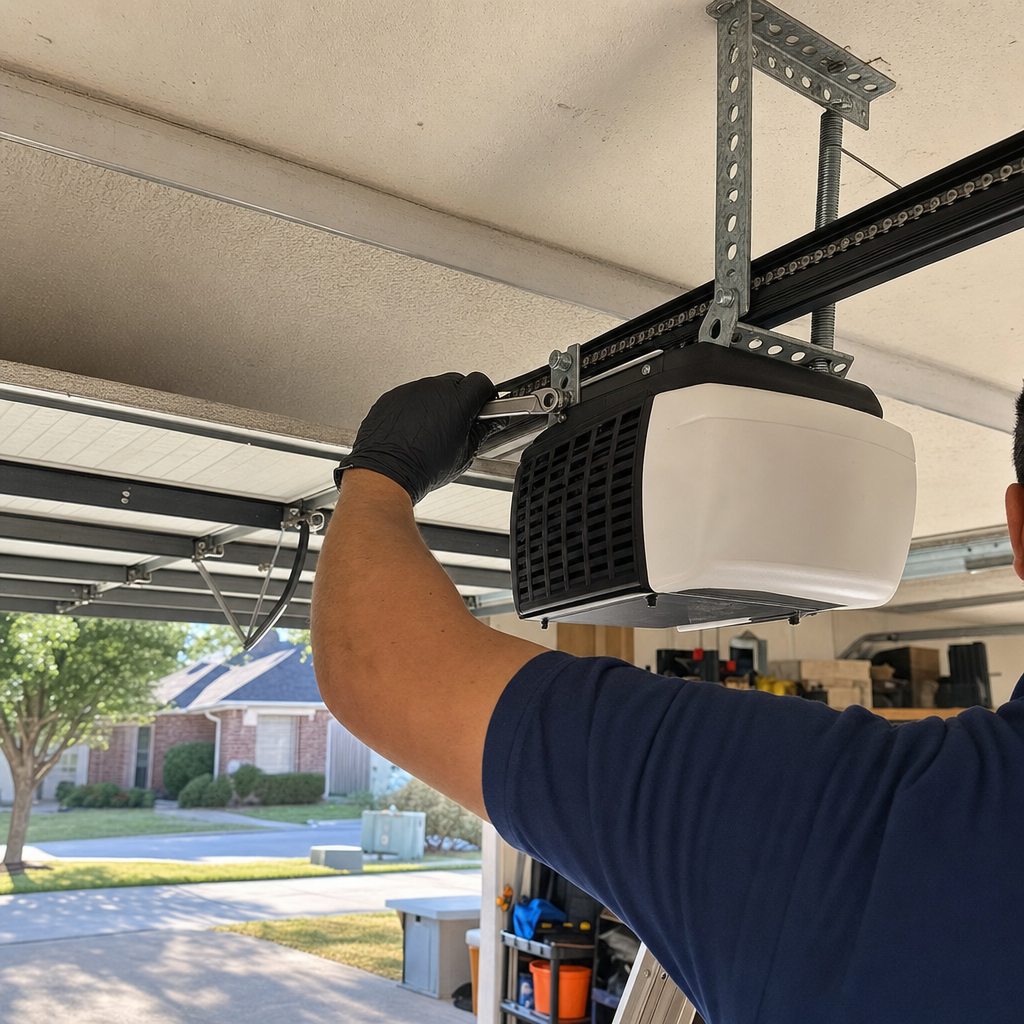
At Garage Door Opener in Irving, we stock replacement logic boards for all major brands — Chamberlain, LiftMaster, Craftsman, and Raynor — because August failures are predictable enough that we plan for them. Most homeowners who call us in September are replacing a logic board that showed warning signs in August if they’d known to look.
In Irving’s market, a logic board replacement runs $180–$340 depending on opener model and whether we catch it before secondary motor damage occurs. The August check costs nothing if you do the visual inspection yourself, or it’s included in our standard service call if you’d rather have Frank Hughes take a look.
October Prep: The 20-Minute Routine That Prevents 80% of Winter Calls
The first real cold snap in Irving typically hits between November 15 and December 1. The week after, our phone explodes. But the failures didn’t start that week — they started when metal components contracted for the first time after months of thermal expansion, exposing cracks, wear, and loosened hardware that summer heat had masked.
Our October routine takes 20 minutes and addresses the specific failure patterns we’ve documented across 570+ Irving service calls:
- Tighten every nut and bolt on the door system. Heat expansion and vibration loosen hardware over a full summer. Use a socket wrench on track brackets, roller brackets, and opener mounting hardware. Don’t over-torque — snug, then a quarter turn.
- Inspect torsion springs for gap formation. Look between coils. A gap wider than 3/16 inch indicates the spring has lost tension and is working harder to lift the door. Cold weather will finish it off. Do not attempt to adjust or remove torsion springs yourself. These components store lethal energy. We’ve treated homeowners who attempted DIY spring work — the injuries are severe and permanent.
- Test door balance with the opener disconnected. The door should stay at half-open without drifting. If it falls or rises, the spring system is out of balance and overworking the opener. This gets worse in cold weather when lubricants thicken.
- Lubricate the entire system with low-temperature garage door lubricant. Standard lubricants gel below 40°F. Irving hits that regularly in January. We see opener gears stripped and rollers cracked because homeowners used summer-weight lube year-round.
- Inspect and replace bottom weatherstrip if cracked or daylight-visible. Irving’s winter wind comes from the northwest, straight across open prairie. A 1/8-inch gap at the bottom of your door is a heat-loss channel that also lets moisture freeze your door to the concrete.
- Test safety reverse with a 2×4 board. Cold weather thickens grease and slows door travel. If your safety reverse is already at the edge of its sensitivity range, the door may not reverse properly under winter load.
Homeowners in the Cottonwood Valley and MacArthur Park areas get hit hardest because their homes face northwest exposure — the prevailing winter wind direction. A door that seals adequately on the east side of Irving may leak badly on the west side. We’ve replaced weatherstripping on hundreds of northwest-facing doors that “seemed fine” in summer.
How Irving’s Freezing Rain Stresses Doors Differently Than Dry Cold
Here’s where national maintenance guides fail Irving homeowners completely. Most cold-climate advice assumes dry cold — think Minnesota or Denver. Irving gets something worse: freezing rain events that coat every surface in ice, then melt partially, then refreeze.
This cycle creates three specific failure modes we don’t see in dry-cold markets:
- Door-to-concrete freezing: Melted snow or rain pools at the door threshold, then overnight temperatures in the mid-20s freeze it solid. The opener tries to lift a door bonded to the floor. If the door is already stiff from thickened lubricant, something gives — usually the opener gear or a bottom roller. In the Shady Grove area after the 2023 ice event, we replaced twelve openers in three days from this exact cause.
- Weatherstrip tearing: When a frozen door is forced open, the rubber weatherstrip tears away from the retainer. Dry cold doesn’t do this — it’s the ice bond that creates the destructive force. Once torn, the weatherstrip can’t be reinstalled; it’s a full replacement.
- Track ice buildup: Freezing rain enters the track gap at the top of the vertical section, then flows down and freezes in the lower curves. Rollers hit these ice dams and either jump track or shatter. We’ve extracted more rollers from frozen tracks in Irving than in any other climate condition.
The prevention is specific: before forecast freezing rain, apply a thin film of silicone spray to the bottom weatherstrip surface and the inside face of the bottom panel. This prevents ice bonding without affecting the seal. For track protection, stuff a rag loosely in the top of each vertical track to block water entry — remove it after the event.
After freezing rain, never force a stuck door. Use a hair dryer or heat gun on low setting to melt the threshold ice bond. If the door still resists, the ice may have penetrated the track system — call before forcing it and causing component damage.
For Garage Door Repair in Irving, freezing rain events are our most predictable surge period. The homeowners who fare best are those who did the October prep and know not to force a frozen door.
Spring Reset: Why Temperature-Cycled Springs Need Re-Inspection
By March, your garage door system has survived the hardest test it faces all year: thermal cycling. Irving’s winter temperature swings — 70°F afternoons dropping to 28°F overnight — cause metal components to expand and contract repeatedly. No other season matches this stress magnitude.
Torsion springs are the critical component. They’re engineered for approximately 10,000 cycles under stable conditions. But temperature cycling accelerates metal fatigue in ways that simple cycle counting doesn’t capture. A spring that “looks fine” in February may have micro-fractures that propagate rapidly once warming begins.
Here’s what we check in our spring reset — and what you should observe even if you’re not doing the work yourself:
- Coil spacing consistency. After a full winter, spring coils should maintain uniform spacing. Any section where coils are tighter or looser indicates uneven tension distribution and impending failure.
- Spring anchor bracket stability. The bracket that anchors the spring to the header wall takes enormous torque. Temperature cycling loosens lag screws in wood framing. We find loose anchor brackets on roughly 30% of post-winter inspections in Irving homes built before 2000.
- Cable wear at the bottom fixture. Cables flex with every door cycle, but winter stiffness increases the flex angle at the bottom. Fraying at this specific point is the leading cable failure mode we see in March and April.
- Opener force settings. Most homeowners never realize their opener has adjustable force settings for up and down travel. These were likely adjusted upward during winter to compensate for stiff components. If not reset for spring, the opener will slam the door with excessive force, accelerating track and panel wear.
In the University Hills and Plymouth Park neighborhoods, we see a cluster of spring failures every March that directly correlate to homes that skipped winter maintenance. The spring didn’t break because of spring — it broke because winter damage accumulated unchecked.
After eight years tracking these patterns, our data is clear: a March inspection costs $0–$85 depending on what we find. A March emergency spring replacement runs $280–$450. The math favors the inspection.
Common Mistakes to Avoid
- Using WD-40 as garage door lubricant. In Irving’s heat, WD-40 evaporates within weeks and leaves a gummy residue that collects dust. We’ve replaced hundreds of rollers and hinges destroyed by well-intentioned WD-40 applications. Use silicone-based or lithium-based products labeled specifically for garage doors.
- Ignoring morning-only testing. Testing your door at 8 a.m. tells you nothing about August afternoon performance. Run your full diagnostic — especially opener thermal behavior — during the hottest part of the day.
- Waiting for visible spring damage. By the time a torsion spring shows visible gaps or rust, it’s already in failure mode. Irving’s temperature cycling means springs fatigue internally before showing external warning. Annual professional inspection catches what visual checks miss.
- Using the same weatherstrip for five-plus years. North Texas UV exposure degrades rubber compounds faster than national averages suggest. In Irving’s sun exposure, even quality EPDM weatherstrip hardens and cracks within 4–5 years. The “it still looks okay” standard fails here.
- Forcing a frozen door. Every ice event, we get calls from homeowners who heard a “pop” when their door finally broke free. That pop was usually a bottom roller shattering or a cable snapping. The door may work once more, but the damage is done and will fail completely — often at the worst possible moment.
- Assuming new construction means maintenance-free. Irving’s newer developments — Shadow Lakes, Las Colinas additions — often have builder-grade openers and hardware rated for milder climates. These systems actually need more attentive maintenance to survive their first Texas summer intact.
When to Call a Professional
Some garage door maintenance is genuinely DIY-appropriate: visual inspection, weatherstrip replacement, basic lubrication, safety reverse testing. But several scenarios demand professional intervention — both for your safety and because amateur work often creates more expensive damage.
Call a technician immediately for: any torsion spring concern (these store lethal energy and require specialized tools); opener logic board or capacitor issues involving electrical components; track misalignment beyond minor bracket adjustment; door that has come off its rollers; any failure after forcing a frozen or stuck door; recurring opener thermal shutdowns.
At Garage Door Installation in Irving and across our full service range, Sunbelt Garage Door Service Dallas Fort Worth offers free estimates with no trip charge for Irving homeowners. Frank Hughes personally handles technical diagnostics — you’ll speak with the same person who arrives at your door, not a dispatcher reading from a script.
With 8 years in business, 570+ verified reviews averaging 4.7 stars, and hands-on experience across LiftMaster, Chamberlain, Craftsman, Raynor, and all major brands, we diagnose problems accurately the first time. Most repairs are completed in a single visit because we stock parts that smaller operators have to order.
When maintenance reveals a problem beyond your comfort level, or when your door simply won’t move, call (855) 683-6171. We’ll get you straight answers and a clear repair path — no upsell pressure, no mystery charges.
Frequently Asked Questions
Four times yearly: pre-summer heat preparation in May, an opener thermal inspection in August, pre-winter weatherproofing in October, and a spring hardware reset in March after thermal cycling stress. This schedule aligns with Irving’s two harsh seasons and two transitional windows, rather than a generic quarterly calendar that misses our specific climate patterns.
A professional tune-up and safety inspection in the Irving market typically runs $85–$150 depending on door size, opener type, and whether component adjustments or minor parts replacement is needed. This preventive cost compares to $280–$650 for common emergency repairs like spring replacement, opener gear repair, or track realignment that result from deferred maintenance. Call (855) 683-6171 for an exact quote — estimates are free.
Yes, lubrication is appropriate DIY maintenance, but product selection matters significantly in our climate. Use silicone-based or white lithium grease labeled specifically for garage doors — available at hardware stores for $8–$15. Apply sparingly to roller bearings, hinge pivot points, and spring coils. Never use WD-40; in Irving’s heat it evaporates rapidly and leaves a residue that destroys components. Avoid lubricating the track itself — clean tracks with a damp cloth only.
This pattern indicates thermal overload in the opener motor or logic board. As garage temperatures climb past 100°F in Irving summers, components that are already aging or dust-compromised hit their thermal protection threshold. The opener isn’t broken — it’s protecting itself from permanent damage. The underlying cause is usually inadequate ventilation, failing capacitors, or accumulated dust on heat sinks. An August inspection identifies which issue before complete failure.
For Irving homeowners, replacement becomes the better value when repair costs exceed 50% of replacement cost, or when the door is over 15 years old with multiple failing components. A single panel replacement on a discontinued model, plus worn spring and opener issues, often totals $800–$1,200 — approaching the cost of a new insulated door that improves energy efficiency and home value. We assess this honestly; our 8-year reputation depends on recommending replacement only when it genuinely serves the homeowner. Call (855) 683-6171 for a no-pressure evaluation.
Same-day service is available for urgent failures — doors that won’t open, security-compromising damage, or safety hazards like a door off its tracks. For routine maintenance scheduling, we typically book within 2–3 business days. During post-ice-storm surge periods, availability extends based on call volume, though established maintenance customers receive priority scheduling. Emergency garage door service is a core offering, not an afterthought — when your door won’t move, we will.
The Bottom Line
Irving’s climate punishes garage doors with heat expansion, UV degradation, and rapid temperature cycling that generic maintenance schedules don’t address. The homeowner who times maintenance to real local patterns — May heat prep, August opener inspection, October weatherproofing, March spring reset — prevents the failures that drive emergency service calls. The 20-minute October routine alone eliminates most winter service needs we’ve documented across 570+ local calls. Deferred maintenance doesn’t save money; it concentrates costs into urgent, inconvenient, and more expensive failures. Start with the season you’re in now, build the habit, and your garage door system will outlast the neighborhood average by years.
Written by Frank Hughes, Owner & Lead Technician at Sunbelt Garage Door Service Dallas Fort Worth, serving Irving since 2018.